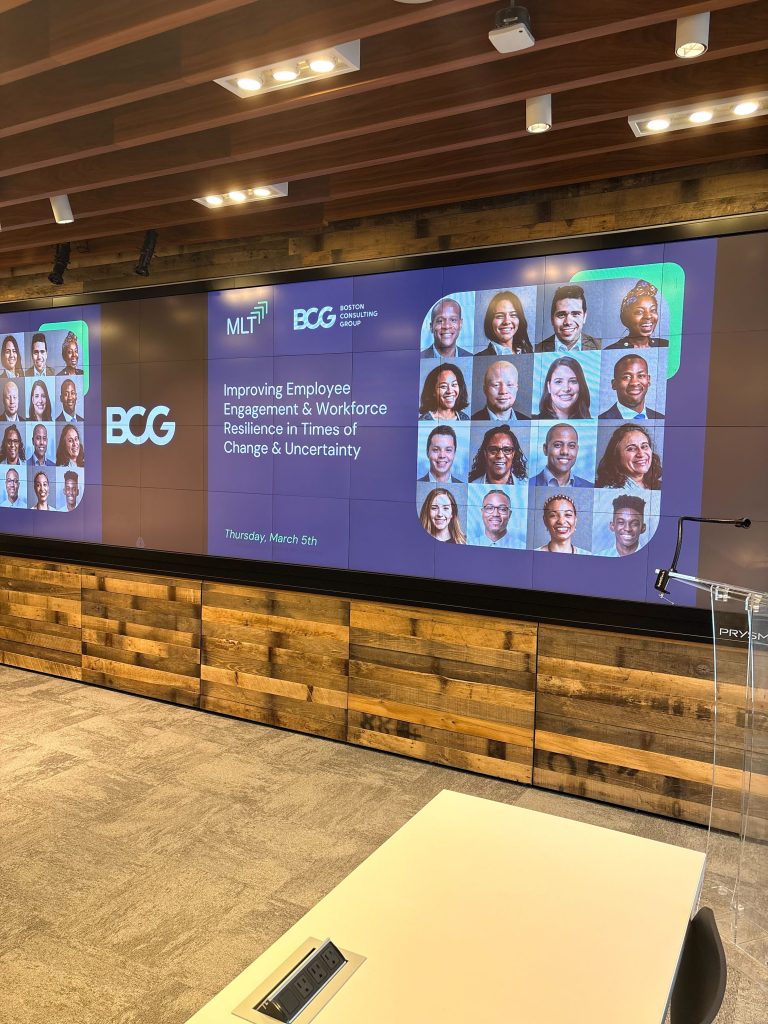
In a candid discussion hosted by MLT and Boston Consulting Group (BCG), senior executives explored how AI is reshaping employee trust, engagement, and the skills leaders must cultivate to build resilient workforces.
Earlier this month, Management Leadership for Tomorrow (MLT) convened senior leaders alongside partners from BCG for a candid conversation about a topic that is increasingly shaping the future of organizations: how leaders can sustain employee engagement and build workforce resilience in an era defined by rapid technological change.
Held under Chatham House Rules, the discussion allowed participants to speak openly about the opportunities and uncertainties created by artificial intelligence and broader shifts in how work gets done. Across industries, from financial services to technology to healthcare, one message came through clearly: AI is no longer a future disruption. It is already reshaping the workforce today.
AI Is Changing Work, But the Real Challenge Is Human
A central theme of the conversation was that while AI is advancing rapidly, the hardest challenges are not technological, they are human. One participant referenced a comment from a major technology CEO who recently observed that the most complex challenges associated with AI are not technical ones, but people challenges. Leaders must now rethink how they communicate with employees, redesign roles, and support teams navigating uncertainty.
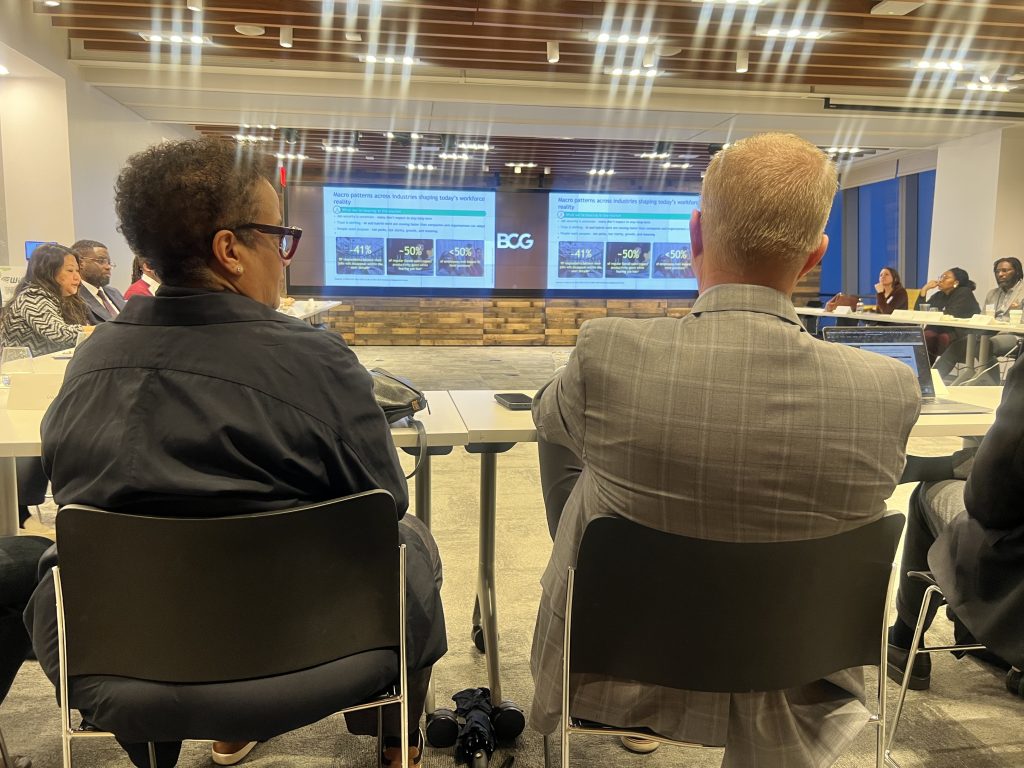
Survey data shared during the session reinforced the scale of the shift. Research conducted across thousands of employees indicates:
- 41% believe their jobs could disappear within the next decade
- Roughly half of regular AI users report productivity gains
- At the same time, many workers remain anxious about how these tools will ultimately affect their roles
This tension between productivity gains and job security fears was a recurring theme throughout the discussion. As one participant noted “AI is clearly making people more productive, but that productivity also raises the question people are asking quietly: If the work becomes easier, will fewer of us be needed?”

The Skills Conversation Is More Important Than the Jobs Conversation
Several leaders emphasized that organizations may be focusing too heavily on predicting specific future jobs rather than preparing employees with durable skills that allow them to adapt. In multiple industries, AI is already shifting how work is structured. Routine analysis, modeling, and documentation tasks are increasingly automated, while human effort moves toward higher-value work such as judgment, strategy, and relationship management. One participant described this shift succinctly “The question isn’t what jobs will exist in five years. The question is whether people have the skills to evolve with the work.” That shift places a premium on skills such as:
- Critical thinking
- Client engagement and relationship management
- Emotional intelligence and empathy
- Cross-functional collaboration
These capabilities remain difficult for AI systems to replicate and will likely become more central to leadership and organizational effectiveness.
Leadership Transparency Is Now a Critical Engagement Lever
Another theme that surfaced repeatedly was trust. Employees increasingly expect leaders to be transparent about how AI will be used within their organizations, particularly when it comes to how roles, performance expectations, and career paths may evolve. Participants shared that uncertainty often erodes engagement more than change itself.
As one executive explained “Employees don’t expect leaders to have every answer. But they do expect leaders to explain how decisions are being made and what principles are guiding them.” Organizations that are building trust successfully tend to share several common practices:
- Establishing clear policies around AI usage
- Investing in training and reskilling
- Communicating openly about how roles may evolve
- Empowering champions within business units to experiment with new tools
These approaches signal that AI adoption is not simply about efficiency, it is about helping employees succeed in a changing environment.
AI Will Create New Roles—But Leaders Must Guide the Transition
While concerns about job displacement were widely acknowledged, participants also discussed how AI is already creating new roles and opportunities. In some organizations, automation is freeing employees from routine tasks and enabling them to focus on more strategic or creative work.
One leader described the shift this way “When people use AI effectively, they often find themselves spending more time on the parts of the job they actually enjoy—thinking, creating, and solving problems.” Still, leaders acknowledged that the transition period may be challenging. Without deliberate investments in re-skilling and role redesign, organizations risk leaving employees uncertain about their place in the future workforce.
The Social Fabric of Work Is Also Changing
Participants also explored how AI adoption is intersecting with another ongoing transformation: hybrid and remote work. While digital collaboration tools have expanded flexibility, some leaders expressed concern that the combination of AI and distributed work could weaken social connections within organizations. One participant reflected “When work becomes more digital and more automated, leaders have to work harder to preserve the human connections that build trust.” Maintaining those connections through mentorship, team cohesion, and leadership visibility, will remain essential for sustaining engagement.
A Leadership Moment
If there was one overarching takeaway from the conversation, it was that the rise of AI represents not just a technological shift, but a leadership moment. The organizations that navigate this transition most successfully will likely be those that:
- Prioritize skills development and adaptability
- Lead with transparency and trust
- Invest in reskilling and workforce mobility
- Help employees see opportunity, not just disruption, in technological change
As one participant summarized near the end of the discussion “AI will change almost every job. The question for leaders is whether employees experience that change as something happening to them, or something they are empowered to shape.” MLT and BCG look forward to continuing this dialogue with leaders across industries as organizations work to build workforces that are not only technologically capable—but also resilient, engaged, and prepared for the future.